
How do you ensure that research does not end up gathering dust, but actually makes a difference for the city? That question was at the heart of the Rotterdam Inclusivity Project Thesis Hub Event, which took place on Tuesday 23 June 2026 at Erasmus University Rotterdam. Master’s students presented their thesis research to representatives of the Municipality of Rotterdam, RADAR, Erasmus University and civil society organisations.
The afternoon clearly demonstrated how valuable it is when science, policy and practice find each other. Because research into discrimination and inclusion only truly matters when its outcomes are actually put to use: in policy, in conversations with residents, in civil society organisations and in the day-to-day work of professionals.
From thesis to city
Within the Thesis Hub, master’s students conduct research on issues related to discrimination, diversity and inclusion in Rotterdam. They do not work solely from within the university, but also maintain contact with policymakers, researchers and civil society organisations.
This makes the Thesis Hub more than an academic programme. The studies generate new knowledge, but also insights that can help make Rotterdam more inclusive.
That connection is precisely what matters. Discrimination cannot be understood through statistics or definitions alone. It is also about people’s lived experiences, about language, perception, policy, reporting behaviour and the feeling of belonging – or not – in a neighbourhood, an organisation or a city.
Why people do not always immediately recognise discrimination
One of the studies examined how ethnically diverse and (perceived) Muslim residents of Rotterdam experience the boundary between everyday and reportable discrimination.
Master’s student Nindjiou Kassogué showed that people do not always immediately recognise experiences of discrimination as such. Sometimes that realisation only comes later – for example through repetition, doubt or conversations with people in their own social circle.
This yields an important lesson: the gap between what institutions formally define as discrimination and how people experience discrimination in their daily lives can be considerable.
This gap was described during the event as an interpretation gap. And that gap matters, because it partly explains why people so often choose not to report discrimination.
The solution therefore does not lie solely in better reporting procedures. There is also a need for recognition, support and space for dialogue, even before someone decides to make a formal report.
For practice, this is an important insight. Those who want to combat discrimination should not only ask: “Why don’t people report?” But also: “When do people recognise what is happening to them as discrimination?” And: “With whom do they feel safe enough to talk about it?”
Master’s student Nindjiou Kassogué presented her research on how ethnically diverse and (perceived) Muslim residents of Rotterdam experience the boundary between everyday and reportable discrimination. Based on in-depth interviews, her research shows that experiences of discrimination are often not immediately recognised as such, but gradually gain meaning through doubt, repetition and the discussion of these experiences in social circles. This gives rise to what she describes as an interpretation gap: a mismatch between the formal, institutional way in which discrimination is defined and the way residents of Rotterdam experience, interpret and discuss discrimination in everyday life. The findings suggest that the solution to the well-known reporting gap therefore does not lie exclusively in better reporting procedures, but also in greater societal and political recognition, administrative support and the initiation of dialogue before people have even labelled their experience as discrimination or reached out to a reporting centre.
In the reflection, the discussants highlighted how these insights connect to practice. City Warden Ton van der Leck advocated for greater attention to everyday experiences of discrimination as a starting point for strengthening social cohesion. In a superdiverse Rotterdam, he argued, attention must remain on ‘two-way integration’. Bauke Fiere (research coordinator at Anti-Discrimination Bureau RADAR) emphasised the importance of communicating more clearly to people about what kind of support anti-discrimination services can offer. Denise Zending (policy advisor Inclusive Living) pointed to the value of the social negotiation of discrimination, such as the conversations in which experiences of discrimination are either validated or minimised.
What political framing does to public perception
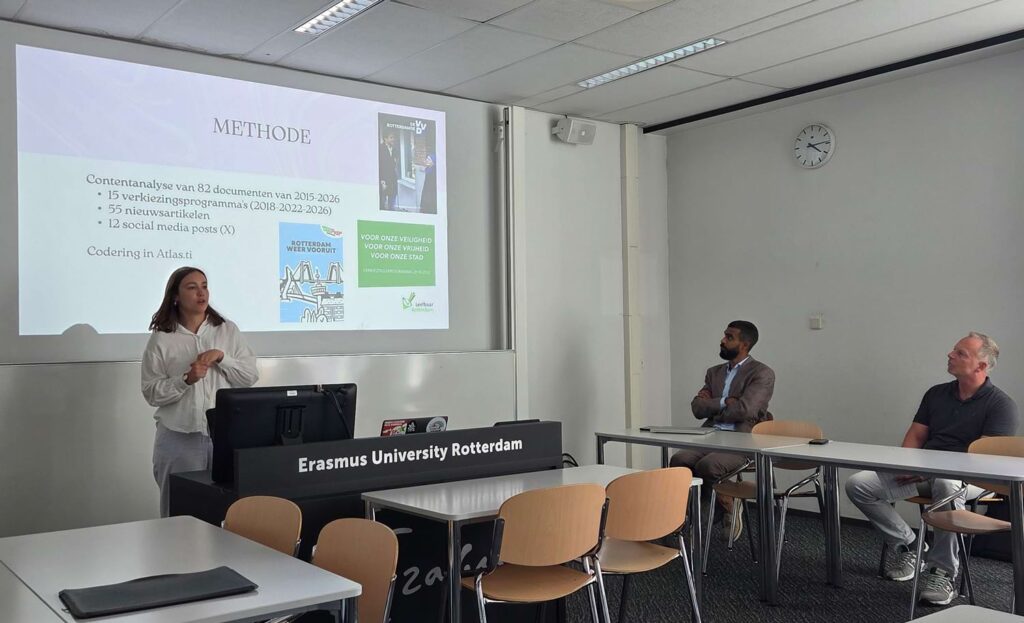
A second study focused on street harassment in Rotterdam politics. Master’s student Sophie Tuik examined how street harassment is framed in election manifestos, news articles and social media posts.
Her research shows that street harassment is not only discussed as a form of gender-related violence. The subject is also regularly linked to themes such as immigration, integration and public safety.
This matters, because framing influences how a problem is understood. The way political parties and media discuss a topic partly determines which causes are emphasised, which solutions seem logical and which groups are seen as the problem or as victims.
In doing so, this research touches on a broader question: how do we talk about social problems in Rotterdam? And what happens when issues of safety, gender, background and integration become intertwined?
During the discussion, it was emphasised that this is not a new phenomenon. The connection between social issues, background and integration has been recurring in public and political debate for some time. That is precisely why further research is important: how does this framing develop over the years, and what does it mean for policy and public perception?
Master’s student Sophie Tuik then presented her research on how street harassment is framed within Rotterdam politics. Based on an analysis of 82 election manifestos, news articles and social media posts, she shows that street harassment is not approached exclusively as a gender-related issue, but is also regularly linked to themes such as immigration, integration and public safety. As a result, the focus shifts from street harassment as a form of gender-related violence to broader debates about culture and background. The research shows that political framing not only influences policy choices, but also determines which causes are emphasised and which groups are positioned as the problem or as victims.
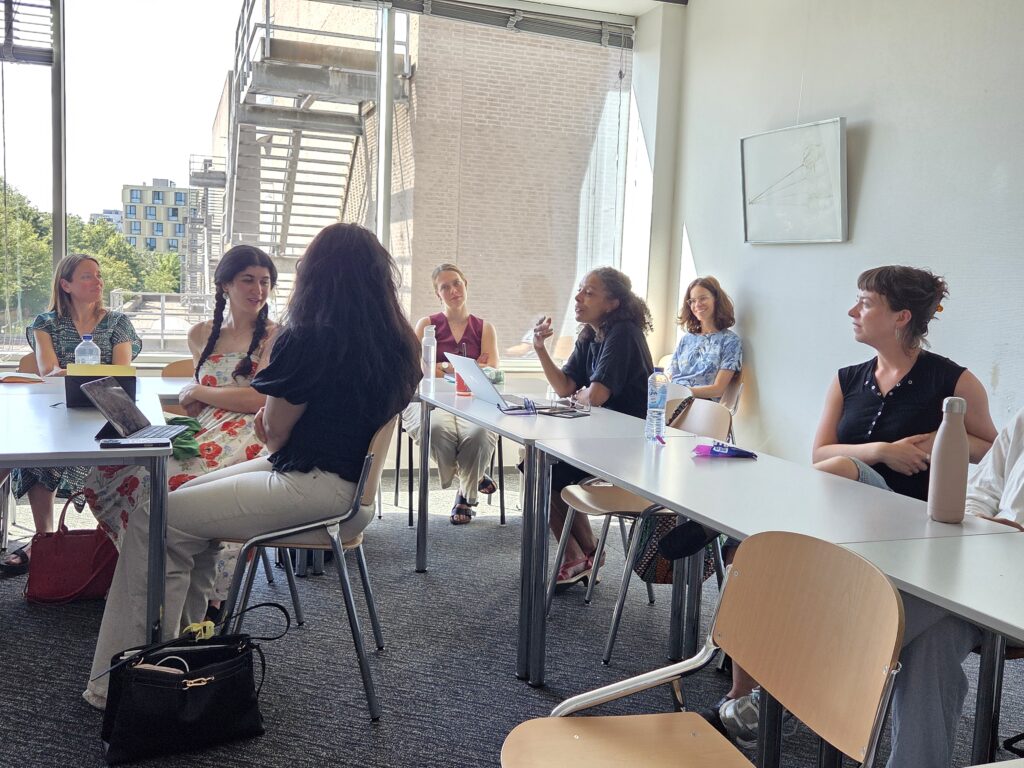
In the subsequent discussion, Denise Zending placed these findings in a broader historical context. She noted that the connection between social issues, background and integration has recurred in political debate ever since the arrival of the first migrant workers, regardless of the specific groups in question at any given time. Maria Schiller pointed to the importance of further research into how this political framing has developed over the (election) years. It was also discussed how the research findings could be used to engage municipal politicians in a conversation about the influence of political framing on policy and public perception.
A broader perspective on inclusion
In addition to these two presentations, attention was also given to three other thesis studies from the Thesis Hub.
- Sophie Harweg examined how European anti-discrimination directives are applied in Malmö and Rotterdam. Her research shows that cities can learn from each other when it comes to designing anti-discrimination policy.
- Floor de Haas examined the meaning of self-reliance in the civic integration of recognised refugees. In practice, it turns out that people are often not required to be “self-reliant” on their own, but rather depend on support from their social environment. Social workers therefore also refer to this as “collective resilience”.
- Veerle Berk conducted research at Huize Middelland, a community centre organised and run by local residents themselves. Her research shows how important informal social welfare organizations are for people’s sense of belonging in a neighbourhood.
Together, the studies demonstrate how broad the theme of inclusion truly is. It encompasses policy, reporting procedures and political language, but also community centres, social networks, civic integration and the ways in which people support one another.
What does Rotterdam gain from this?
The value of these studies does not lie only in their individual conclusions. Taken together, they paint a richer picture of inclusion in Rotterdam.
They show that discrimination and exclusion are not separate from other social issues. There is a clear interconnection between the lived experiences of residents, policy, political narratives, social networks and the way organisations provide support.
For Rotterdam, this means that knowledge from research can help to ask better questions. For example:
- How can policy better connect with the everyday realities of Rotterdam’s residents?
- How can we ensure that discrimination is better recognised, so that people also feel legitimised to raise or report discrimination?
- How do we prevent research from sitting on the shelf?
- And how do we translate knowledge into concrete actions in neighbourhoods, organisations and policy?
The role of the Discriminatiewijzer
The Discriminatiewijzer aims to contribute precisely to that connection. By making knowledge, data and insights about discrimination and inclusion accessible, it creates a foundation for dialogue, policy and action.
For policymakers, the Discriminatiewijzer provides substantiation. For professionals, the site offers context for what they encounter in practice. For civil society organisations, the information can support awareness-raising, advocacy and assistance. And for residents, the site provides insight into what is happening in their city.
The Thesis Hub Event showed that research does not have to be an endpoint. On the contrary. It can be the beginning of a conversation: between science and policy, between professionals and residents, and between data and lived experience.
When that connection succeeds, research becomes a driver of change.
And that is precisely what is needed to work together towards a Rotterdam where inclusion and equal treatment are continuously strengthened.